
Selection & System Sizing
18650 vs. 21700: How Should Battery Pack Buyers Choose?
Compare cell availability, pack dimensions, current sharing, thermal layout, assembly count and validated model performance.
Quick answer
Choose between 18650 and 21700 from the complete pack design. 21700 cells can reduce cell count for a given energy when the selected model has higher capacity, while 18650 cells offer a broad established supply base and can fit slimmer geometries. Format alone does not determine capacity, power, cycle life or quality.
Format-to-pack comparison
Compare the format, then validate the exact cell.
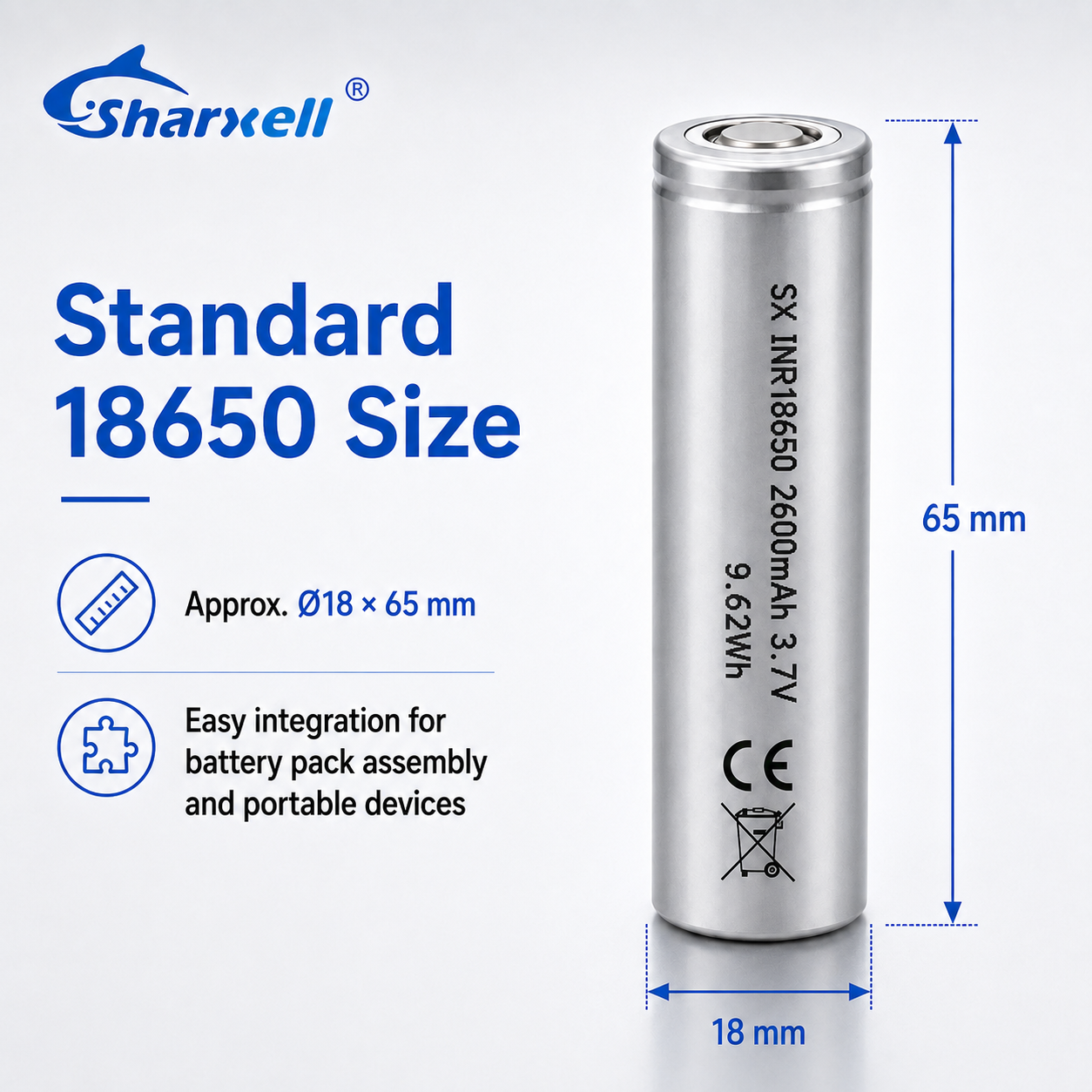
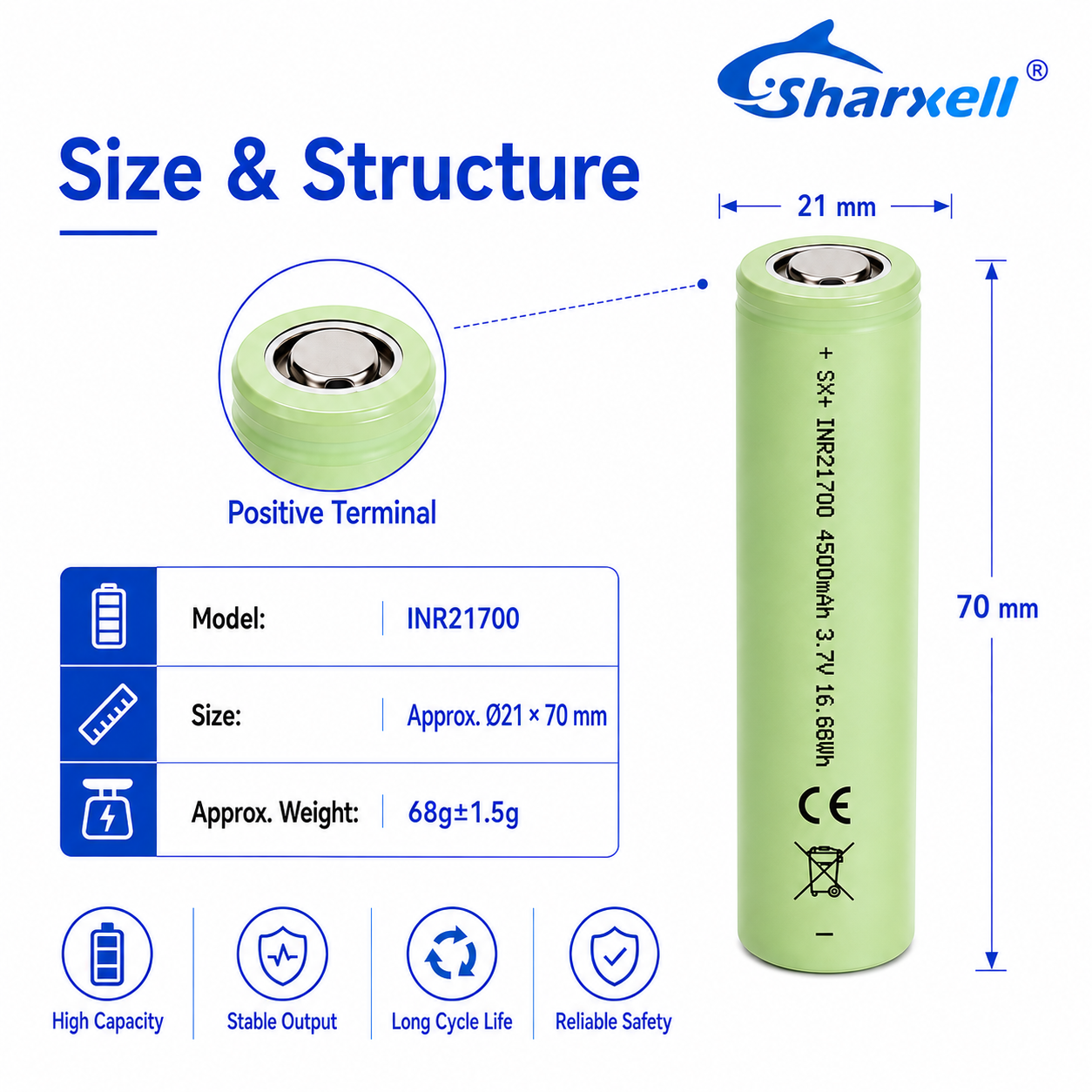
The capacity and energy printed in these Sharxell product images belong to the pictured models only. They are not format-wide specifications.
Diameter / length
Approximately Ø18 × 65 mm.
Approximately Ø21 × 70 mm.
Typical capacity / energy
Pictured product example: 2.6 Ah / 9.62 Wh. Industry offerings vary by chemistry and model.
Pictured product example: 4.5 Ah / 16.65 Wh. Industry offerings vary by chemistry and model.
Cell count implications
A lower-Wh selected cell may require more parallel cells for the same target pack energy.
A higher-Wh selected cell may reduce cell and weld count, subject to the actual model.
Pack geometry
Smaller cylinders can suit slim, stepped or space-constrained layouts.
Larger cylinders can simplify some layouts but may not fit a narrow enclosure.
Current capability
Not defined by format. Confirm continuous current, pulse definition, resistance and temperature rise.
Not defined by format. A larger cell is not automatically a higher-power cell.
Thermal / assembly
More cells can mean more welds, interfaces and monitoring points.
Fewer cells may simplify assembly; spacing and individual-cell heat still require validation.
Typical applications
Illustrative fit: mature portable products, compact packs and established replacement designs.
Illustrative fit: e-mobility, power tools and energy-dense packs where enclosure space allows.
Procurement decision
Choose when the validated pack geometry, duty cycle and stable model supply support it.
Choose when fewer cells or higher per-cell energy improves the validated pack—not for the format name alone.
Read the format comparison correctly
The names describe approximate cylindrical dimensions: 18650 is about 18 mm in diameter and 65 mm long; 21700 is about 21 mm in diameter and 70 mm long. The images above show real Sharxell product examples, while the comparison rows separate those pictured-model values from general format tendencies. Exact dimensions, terminal construction, capacity, power capability and tolerances remain model-specific.
The application examples in the comparison are illustrative industry fits, not limits on where either format may be used. Pack requirements and validation decide the final choice.
Compare exact cells at the required duty cycle
Ask for confirmed values for capacity, nominal voltage, DC internal resistance test method, continuous current, pulse definition, charging limits, temperature range and cycle-life conditions. A high-capacity cell and a high-power cell of the same format can behave very differently.
For pack energy:
Pack nominal energy ≈ series count × nominal cell voltage × parallel count × cell capacity
For pack current, the parallel count shares load only when cells and interconnects are suitably matched. BMS and conductor limits still apply.
Mechanical and manufacturing effects
A lower cell count can reduce welds, holders and monitoring points, but it may not create the smallest pack if the available space favors 18650 geometry. Review enclosure clearance, vibration support, cell spacing, service access and thermal propagation controls.
Changing format requires new validation of welding parameters, interconnect temperature, drop/vibration resistance, protection operation and charger compatibility.
Procurement decision
Provide target pack voltage and energy, continuous/pulse power, maximum dimensions and mass, duty cycle, temperature, quantity, certification destination, connector and charger. Request a cell-level and pack-level bill of characteristics rather than approving a format name alone.
The strongest choice is the validated pack that meets the application with stable cell supply—not a generic claim that one diameter is superior.
FAQ
Is every 21700 cell more powerful than every 18650 cell?
No. Current capability depends on the exact cell design. Compare confirmed capacity, resistance, continuous and pulse current, temperature and cycle data.
Can a pack be changed from 18650 to 21700 without redesign?
Usually not. Cell holders, enclosure, interconnects, thermal behavior, series/parallel count, BMS settings and validation may all change.